Does Democracy Need a New Operating System?
What if participating in politics were as easy as filing a support ticket? Magnus Strobel of Nexus Politics on why democracy has a UX problem - and what an AI-powered platform can do about it.

Fixing Democracy's User Experience: A Conversation with Magnus Strobel
Here's a scenario most of us know: you have a problem - a dangerous intersection, a policy that isn't working - and you want someone in government to know about it. You find an email address that might be right. You send a message. You get a polite reply thanking you for your concern. And then nothing. The problem disappears into an inbox.
That's not a failure of democracy. That's a failure of process. And that's what Magnus Strobel and his co-founder Christoph Waffler are building Nexus Politics to fix.
Listen to the full episode here! 👉 Spotify | Apple

Subscribe to our newsletter! 👉 Subscribe Now!
Get more conversations, tools and stories for impact founders straight to your inbox.
The Problem Isn't Democracy - It's the Workflow
Magnus makes a distinction that stuck with us long after this conversation: people aren't dissatisfied with democracy itself. They're dissatisfied with how democracy functions. The values are fine. The plumbing is broken. Citizens don't know who's responsible for what in a federal system with layers of municipal, state, and federal jurisdiction. Politicians receive floods of emails - 30 to 40 percent of which don't even fall within their area of responsibility. And once a concern is submitted, there's no way for citizens to track what happens to it. In any other industry, that would be called a terrible customer experience. In politics, it's just how things work.
What Nexus Politics Actually Does
You describe your problem in a chat interface. The AI asks follow-up questions until it fully understands the issue. It generates a structured summary - your "problem ticket" - and automatically routes it to the responsible political bodies based on jurisdiction and topic.
From there, you can track what happens. Existing petitions, parliamentary readings, public participation formats - Nexus Politics aggregates all of it into one timeline. Politicians, meanwhile, get a dashboard showing not individual complaints but patterns - clusters of related concerns that help them see the forest, not just the trees.
From Behavioral Economics to Democratic Infrastructure
Magnus didn't start in politics. He studied economics after the 2008 financial crisis, earned a PhD in behavioral economics at TU Munich, and worked in finance. The thread connecting it all is human behavior: why people make the decisions they do, and how systems can be designed to nudge them toward better ones.
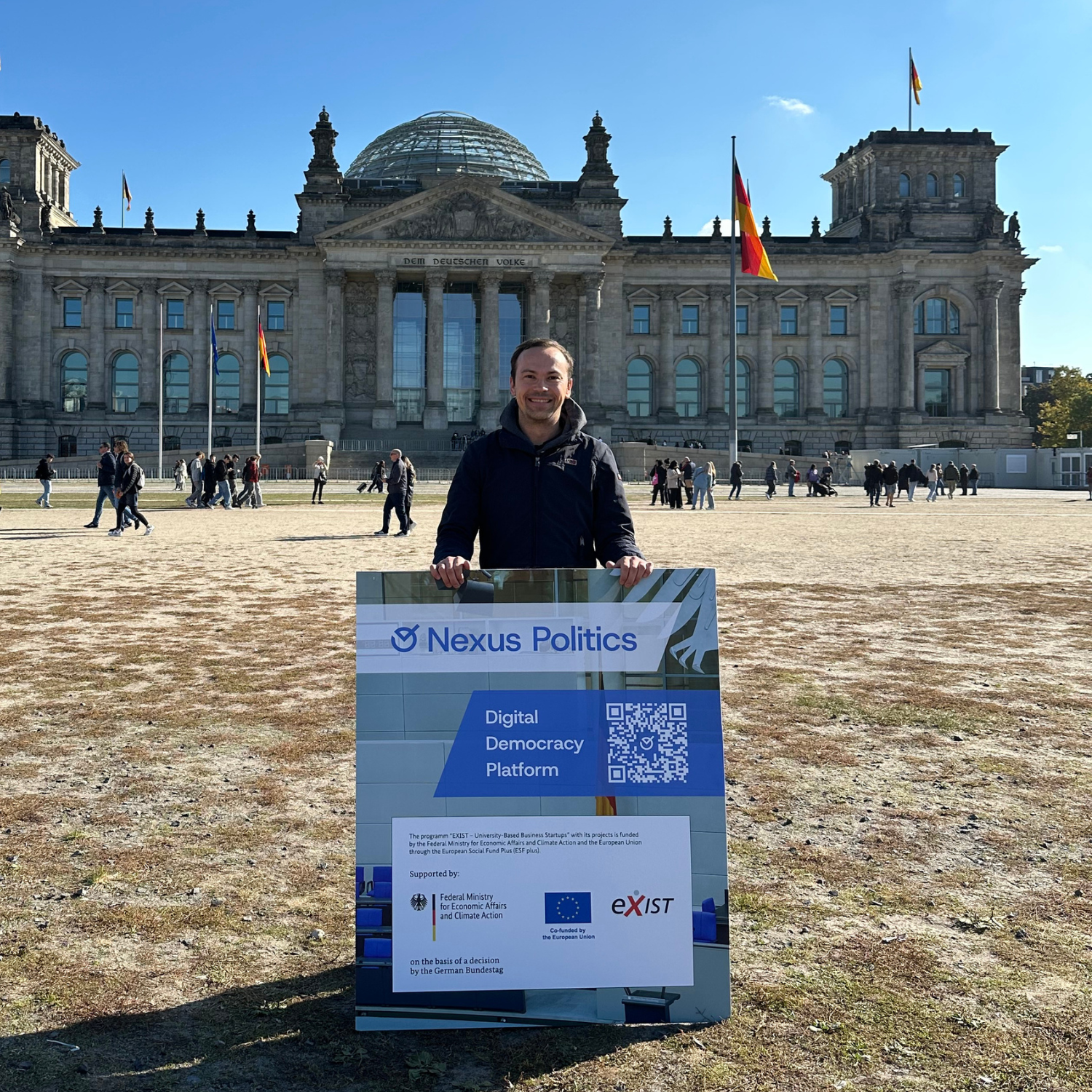
That's what Nexus Politics is - a behavioral design project applied to democracy. Make participation easier, and more people participate. Make responsiveness visible, and politicians become more responsive. His co-founder Christoph Waffler brings the technical side - computer science, also from TUM. Together they received an EXIST startup grant, are based in the TUM Incubator, and are supported by TUM's Professorship of Policy Analysis.
Why They Chose UG Over gGmbH
Nexus Politics is a for-profit UG - not a nonprofit. That's deliberate: they want to scale internationally (nonprofit German legal forms don't travel well), they want to stay politically neutral (taking money from politically affiliated foundations would compromise that), and they don't want to compete for grant funding that other civil society organizations need more.
Their revenue model is SaaS. Politicians pay for tools on a freemium model: a free public profile, a basic tier at €29/month for constituent management, and a premium tier at €99/month for surveys, analytics, and the full toolkit. They've priced it below public procurement thresholds, so any politician can subscribe without a formal tender process.
What's Next
Magnus points to Taiwan as proof of concept - after former Digital Minister Audrey Tang implemented a participatory platform, public satisfaction with how government functions shot from low double digits to over 70 percent. The principle is the same: give citizens clear, transparent access to political processes, and trust goes up.
The Nexus Politics platform is live. The team has grown to twelve people. They're onboarding politicians across Germany, with international ambitions - Vienna, Bologna, and eventually the EU and beyond. They're also part of the Social Impact Republic, which connected them further with infrastructure and networks. Magnus puts it simply: when you think of professional networking, you think LinkedIn. The goal is that when you think of political participation, you think Nexus Politics. After listening to this conversation, that doesn't sound unreasonable.
Listen to the full episode here! 👉 Spotify | Apple
Join our community for insights, events, and new episodes. 👉 Follow us Now!